
Where Did I Read That?
You are halfway through the related work section when you remember it. A paper that said exactly what you need. You can almost see the figure, two curves crossing near the middle, and you are fairly sure it was from last spring.

You are halfway through the related work section when you remember it. A paper that said exactly what you need. You can almost see the figure, two curves crossing near the middle, and you are fairly sure it was from last spring.
You do not remember the title. You do not remember the authors. You open the folder where it should be and find a few hundred files, some named things like final, final2 and read later.
Forty minutes later you are still searching, and the sentence you were trying to write is still half finished.
This is more common than it feels
An older survey of 156 researchers at a US university asked how often they failed to retrieve an article they had already read, estimated weekly. 57.7 percent said they failed at least once or twice a week. The same survey found that 78 percent named keeping up with the volume of publications as a major difficulty, the most common problem on the list.
To be fair, this was one university, a small sample and a survey from several years ago, so it is a signal, not a headline. But one interviewee put the experience in words many people will recognize. They said they usually did not succeed in finding all related work, especially the papers they had skimmed without printing or reading closely.
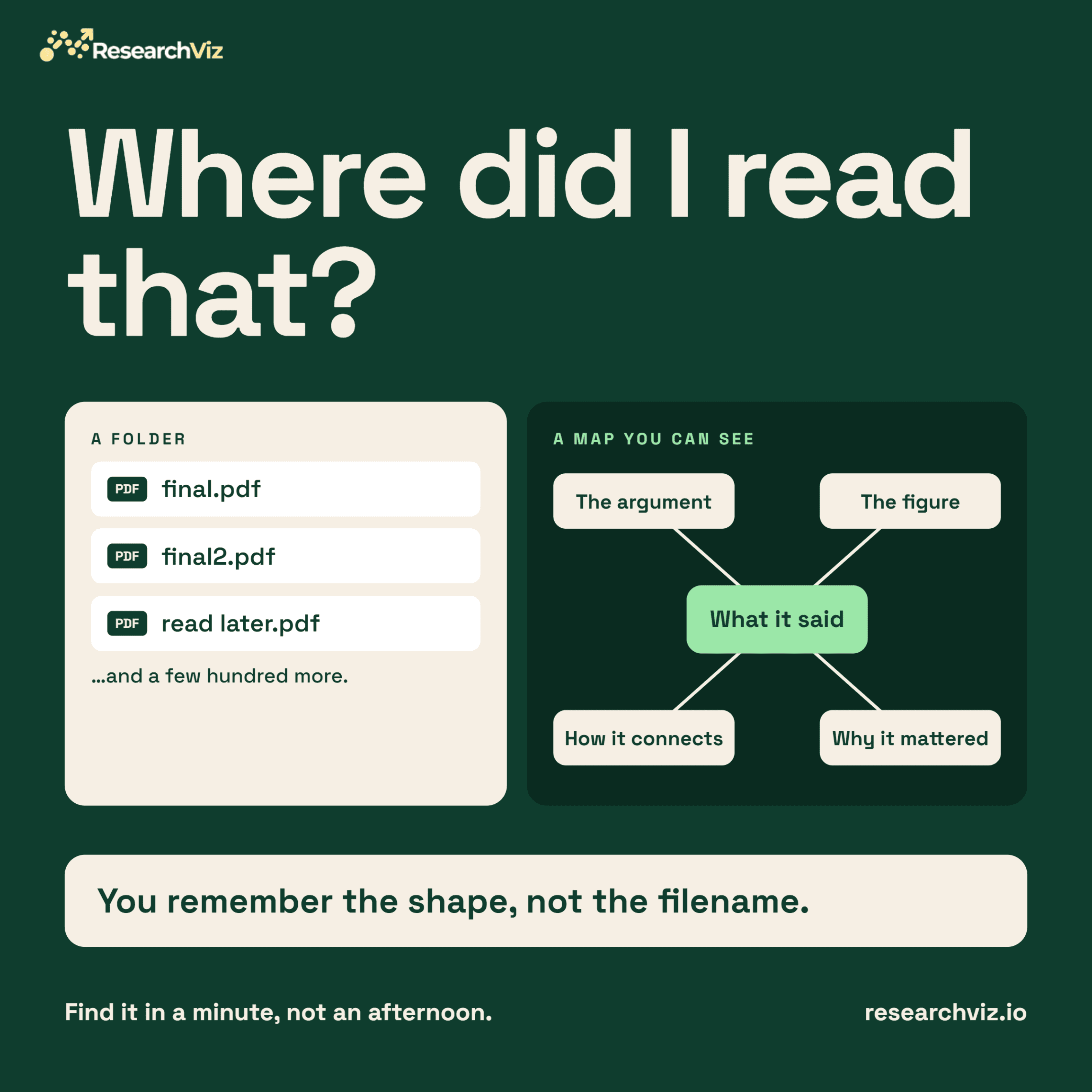
You remember the shape, not the filename
Here is the odd thing about how reading sticks. You remember what a paper said, how its argument moved, the one picture that made it click. You almost never remember the metadata that search tools depend on. A title, an author list and a year are exactly the things that slip away first.
So you end up searching for a memory with tools built for labels. And the papers most likely to vanish are the ones you skimmed, which is also where a useful detail is most likely to be hiding.
A note in your own words beats a filename
Everyone has heard the advice to write a short note on every paper you read. Almost nobody keeps it up. The notes are the first thing to go when a deadline arrives, because they feel like extra work with no immediate payoff, and the payoff only shows up three months later, when you are searching for something you half remember.
What helps is making the note cheap enough to survive a busy week, and giving it a shape you will recognize later, not another block of text to reread.
Where a tool like this actually helps
This is where ResearchViz fits into the reading side of research. Upload the PDF, or paste the abstract, and it can turn the paper into a mind map or a research summary, so the structure of the argument is something you can see at a glance. Its VizBoard workspace keeps a saved history of your runs across sessions, so you can come back to what you generated and regenerate it in a different template if it helps.
It does not replace your reference manager. Keep that for citations and files. Use the visuals for the part those tools cannot hold, what the paper actually said and how it connects to the rest of your reading. And the judgment about what matters in a paper is still yours.
Find it in a minute, not an afternoon
The goal is not to remember everything you read. That was never possible. It is to leave yourself something better than a filename, so the paper you half remember is easy to find when you need it. ResearchViz exists for the researchers who would rather spend their afternoon writing than searching.
Start using ResearchViz
Turn your paper into a graphical abstract, poster, or presentation in minutes. See a sample report or browse all features.
Get started