
The Pile of Papers You Will Never Fully Read
You open your reference manager to start the literature review section. Twenty tabs are waiting. Some are papers you saved months ago and never opened. Some you skimmed once and forgot. A few you have read three times and still are not sure you understood.

You open your reference manager to start the literature review section. Twenty tabs are waiting. Some are papers you saved months ago and never opened. Some you skimmed once and forgot. A few you have read three times and still are not sure you understood.
You have not written a single sentence yet, and you already feel behind.
This is not a productivity problem you can fix with a better calendar. It is closer to a math problem that never balances.
The numbers do not work in your favor
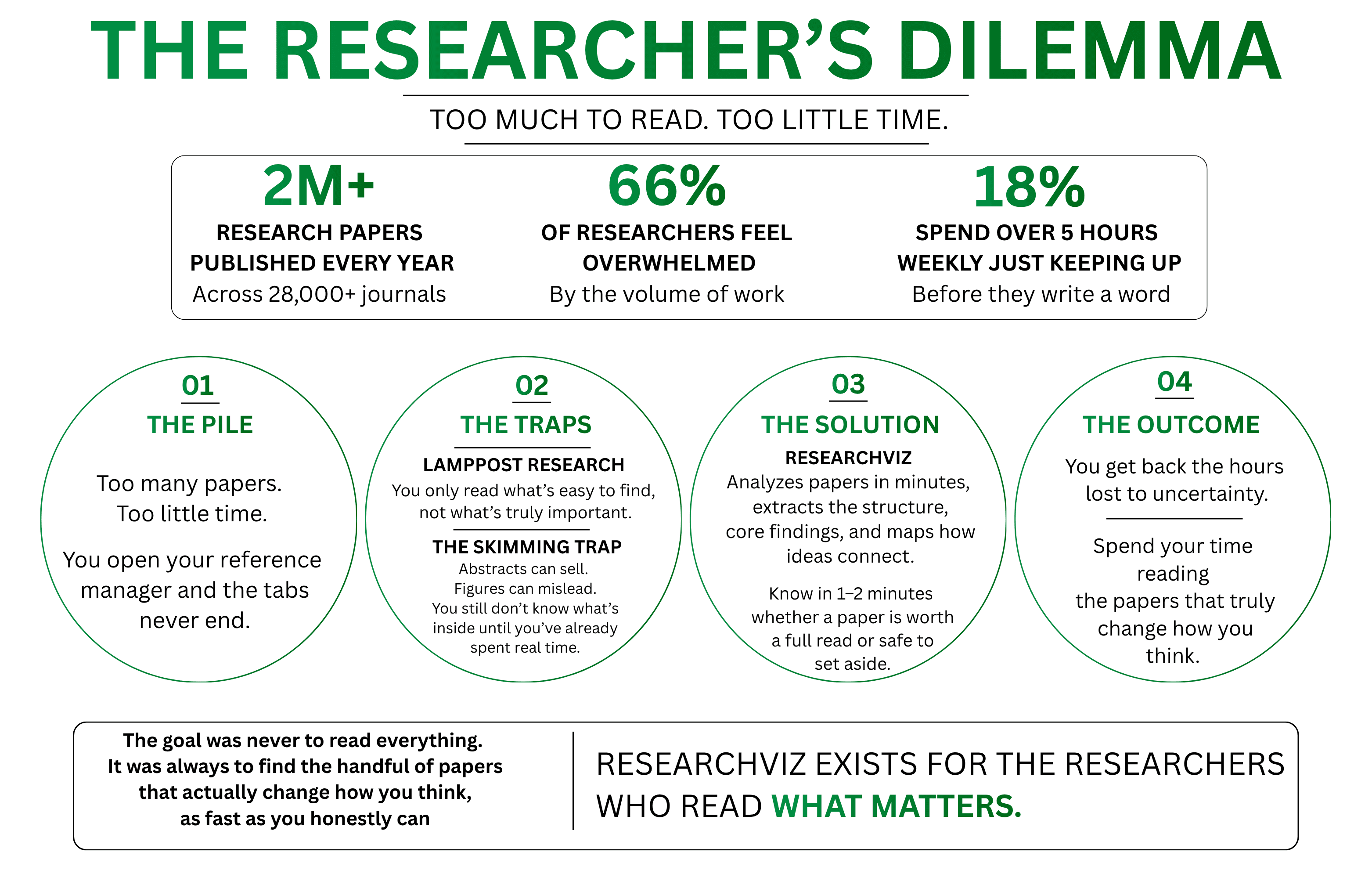
More than two million research papers get published every year, spread across upward of 28,000 journals. A widely cited industry survey found that 66 percent of researchers feel overwhelmed by the sheer volume of published work they are expected to review, and nearly one in five spend over five hours a week just trying to keep up, before they have done a minute of their own writing.
Nobody can read all of that. Nobody is even trying to. The real, quieter fear underneath the overwhelm is not "there is too much to read." It is "how do I know which four or five of these forty papers actually matter, before I spend an afternoon on each one to find out."
The trap researchers do not talk about enough
There is a name for what happens when you give up trying to read everything and just read what you have time for. Researchers sometimes call it lamppost research, after the old joke about a man searching for his lost keys only under a streetlight, not because that is where he dropped them, but because that is where he can see.
The danger is not laziness. It is that your entire argument, your framing, your sense of what is already known in your field, ends up built only on the subset of papers you happened to have time for. Somewhere in the pile you did not get to that one paper that would have changed your whole approach, and you will likely never know it was there.
That is a heavier kind of stress than a deadline. A deadline just asks for your time. This asks whether the foundation of your work is even solid, and there is no clean way to check.
Skimming is not really the answer either
The usual advice is to skim more efficiently. Read the abstract, read the conclusion, glance at the figures. But an abstract is written to sell the paper, not to tell you honestly whether it fits your specific question, and figures without context can mislead as easily as they inform. Skimming faster just means making the same uncertain judgment call more times per hour. It does not actually solve the problem of not knowing what is inside a paper until you have already spent real time inside it.
Where a tool like this actually helps
This is the exact gap ResearchViz is built to close on the reading side, not just the presenting side. Feed it a paper or a PDF, and its analysis tools pull out the structure and core findings fast, and its mind mapping feature lays out how the ideas connect, so you can tell within a minute or two whether a paper is worth a full read or safe to set aside. It does not replace actually reading the papers that matter. What it replaces is the hour you would have spent finding out which ones those are.
That is a real difference. The time you get back is not time you were going to spend thinking anyway. It is time you were losing to uncertainty, to opening one more tab and hoping this one is the one that helps.
A pile you can actually make sense of
The literature will keep growing no matter what you do. Two million papers a year is not slowing down. But the goal was never to read everything. It was always to find the handful of papers that actually change how you think, as fast as you honestly can. ResearchViz exists for the researchers who would rather spend their limited hours reading the papers that matter than guessing which ones do.
Start using ResearchViz
Turn your paper into a graphical abstract, poster, or presentation in minutes.
Get started