
The Paragraph That Might Decide If You Get Funded
The grant application is almost finished. Aims, methodology, budget, timeline, all of it done and polished after weeks of work. Then you reach the last section. Summary for a general audience. Two hundred and fifty words maximum.

The grant application is almost finished. Aims, methodology, budget, timeline, all of it done and polished after weeks of work. Then you reach the last section. Summary for a general audience. Two hundred and fifty words maximum.
You have spent years learning to write with precision for people who already understand your field. Now you have a few minutes left in your evening and a box asking you to explain that same work to someone who might not know what your basic terminology even means.
It feels like an afterthought. It is not one.
This paragraph is doing real work
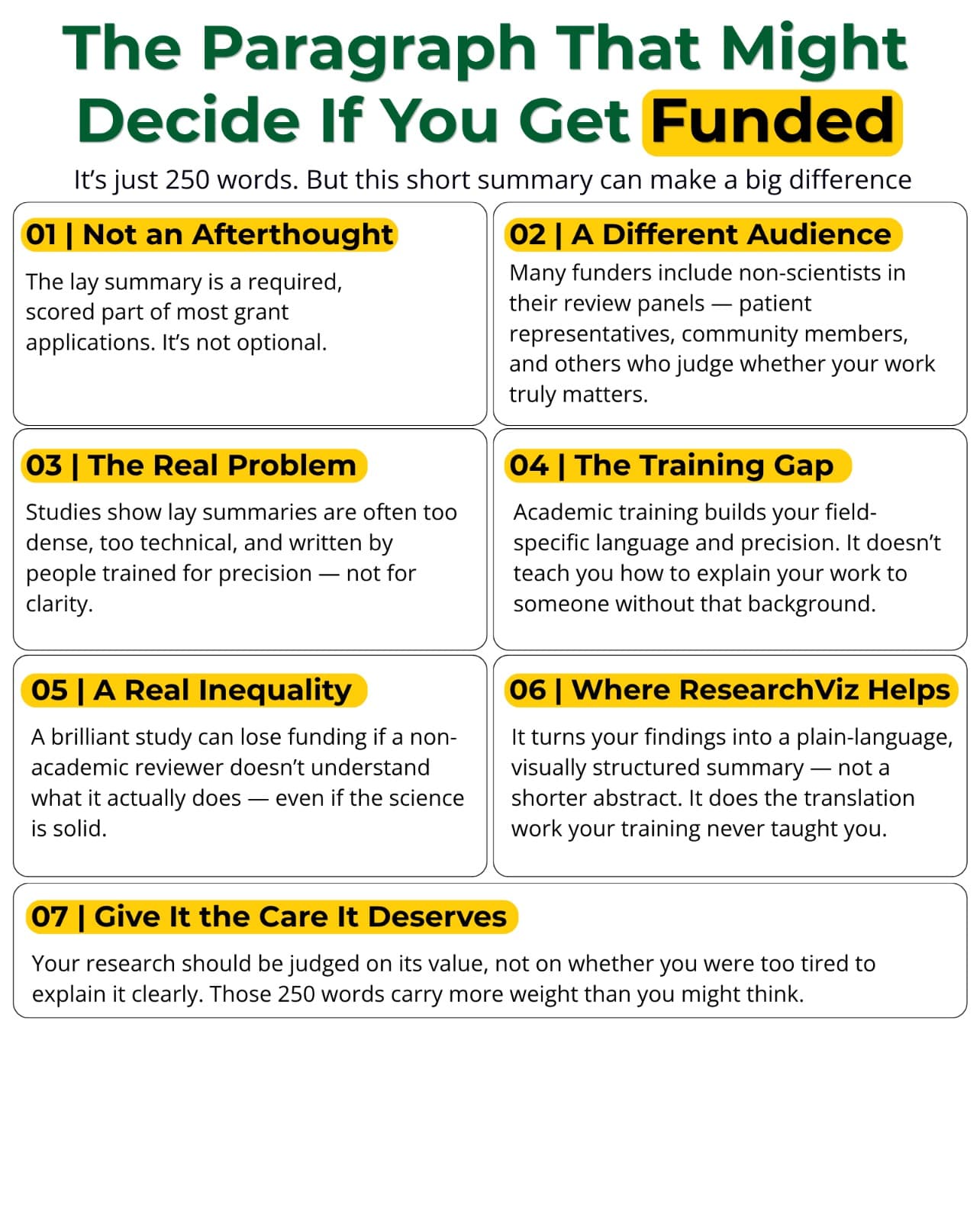
Most major funders now treat a lay summary as a required, scored part of the application, not an optional courtesy. Some funding bodies have required it since as early as 2014. And funding panels increasingly include people who are not scientists at all, patient representatives, community members, reviewers brought on specifically to judge whether the research actually matters to people outside the field.
That means the person deciding whether your work gets money might read your technical methodology and understand very little of it, but read your two hundred and fifty word summary closely, because it is the one part of your application built for them. Studies looking at real submitted lay summaries keep finding the same problem. Too dense. Too technical. Written by someone trained for a decade to be precise for peers, asked at the last minute to be clear for everyone else.
The training gap nobody prepares you for
This is not a writing skill you pick up by accident. Academic training rewards precision, caveats, and field specific vocabulary. None of that transfers to explaining your work to someone without that background, and there is rarely a class for it. You know your research too well to easily tell which parts need explaining and which parts you can assume. The very expertise that makes you qualified to do the research is the same thing that makes it hard to unsee it when you sit down to describe it plainly.
So the summary gets written last, fast, and under the same fatigue as everything else on the application. It gets the least editing of any section, while being read by the reviewer least equipped to fill in the gaps you left out.
The strange unfairness of it
A brilliant methodology can lose funding not because a scientist doubted the science, but because a non academic reviewer never understood what the science was actually going to do. That is a real, documented pattern, and it has nothing to do with whether your research deserves support. It has to do with whether one paragraph did its job on the first read, with no chance for you to clarify or add context afterward.
Where a tool like this actually helps
This is exactly the gap ResearchViz is built to close. Its Funfographic and Research Summary tools take your actual findings and turn them into a plain language, visually structured summary built for a non expert reader, not a shorter version of your abstract, an actually different kind of communication built for the audience that is going to judge it. It handles the translation work that academic training never taught you, so the reviewer who is not a scientist gets a fair, clear shot at understanding why your work matters, instead of whatever got typed in five rushed minutes before a deadline.
Let the paragraph earn its keep
Your research should be judged on whether it deserves funding, not on whether a tired author managed to explain it clearly enough at eleven at night. The two hundred and fifty words at the end of the application carry more weight than their length suggests. ResearchViz exists so that paragraph gets the same care as everything else you built, instead of being the one part nobody had energy left for.
Start using ResearchViz
Turn your paper into a graphical abstract, poster, or presentation in minutes.
Get started