
The Night Before the Poster Is Due, Every Researcher Has the Same Bad Night
It is 11 p.m., the flight is in nine hours, and eighteen months of work is still a half aligned mess of text boxes. Here is why conference posters break so many researchers, and what actually eats the hours before the deadline.

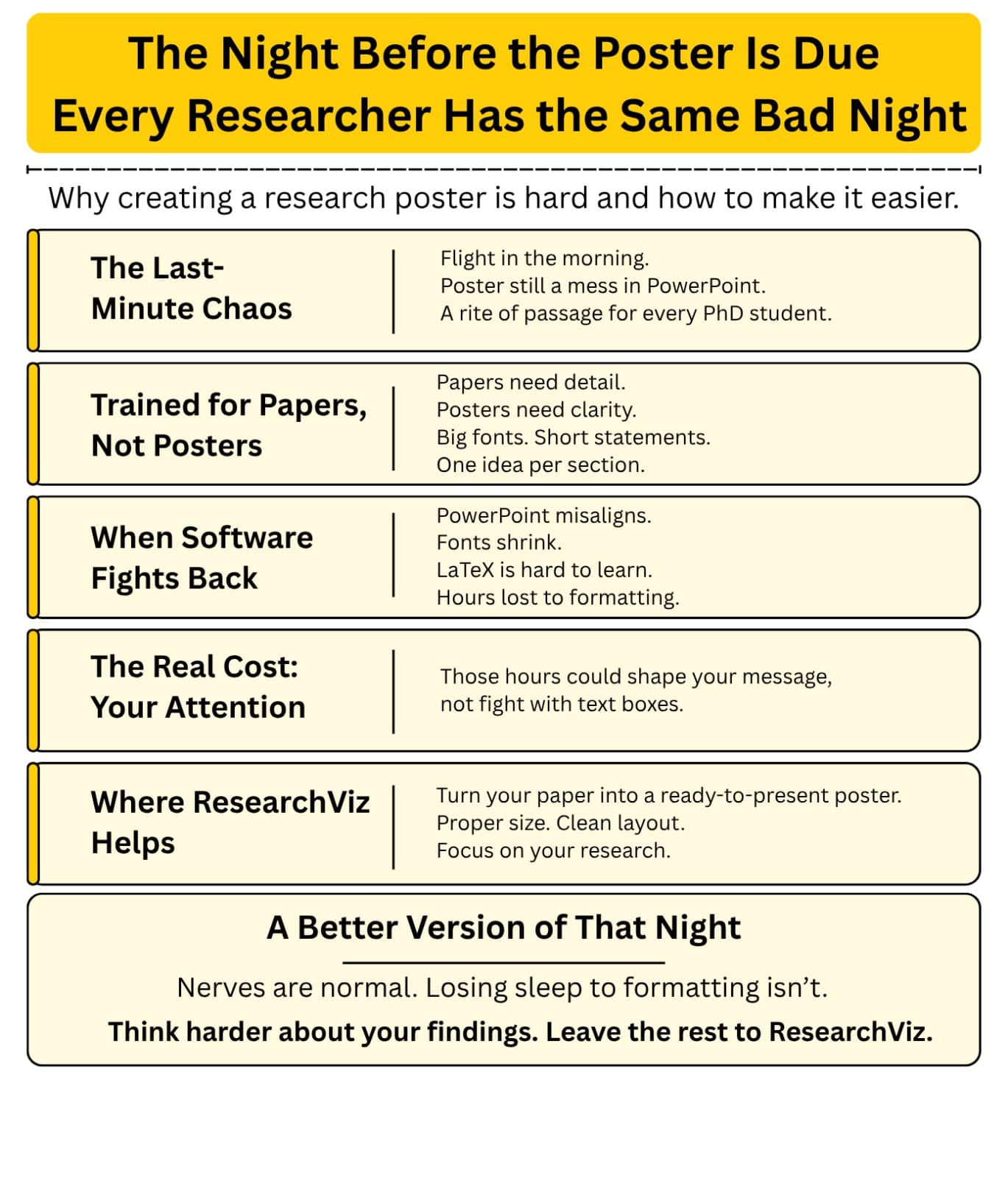
It's 11 p.m. The flight is in nine hours. And the poster, the actual physical thing that's supposed to represent eighteen months of work, is still a half aligned mess of text boxes in PowerPoint.
This isn't a rare disaster. It's closer to a rite of passage. Ask almost any PhD student about their first conference poster and you'll get some version of the same story: a slide that looked fine at normal size and turned into a wall of illegible paragraphs the moment it was blown up to 48 inches wide.
The strange part is that the research itself usually isn't the problem. The problem is the switch nobody warns you about.
You're trained for the opposite skill
Years of academic writing teach you to explain, qualify, and defend. Every claim earns a citation. Every finding gets its nuance. That instinct is exactly right for a paper and exactly wrong for a poster.
A poster has to work from six feet away, held for maybe thirty seconds, on a page most people will skim rather than read. That means text a PhD-trained brain doesn't naturally produce: short declarative statements instead of qualified ones, headline-sized fonts, one idea per section instead of five ideas per paragraph. It's not a smaller version of the paper. It's a different kind of writing, and most researchers are asked to produce it for the first time with a deadline already breathing down their neck.
Then the software fights back
Even once you know what the poster should say, the tools don't make it easy to say it. PowerPoint wasn't built for large format layout, so alignment drifts the moment you resize anything, and a font that looked readable on your laptop can shrink to a squint worthy size once it's printed at poster scale. LaTeX handles the sizing more gracefully, but the learning curve is steep enough that most people don't touch it unless they're already fluent, and troubleshooting it at 11 p.m. is its own special kind of misery.
So the hours before a poster deadline rarely go where they should. They don't go toward sharpening the argument or picking the right figure. They go toward nudging text boxes, second guessing font sizes, and re-exporting a PDF for the fourth time to check if anything shifted. The research was done months ago. The night is being lost to formatting.
The actual cost isn't time, it's attention
That's the part worth sitting with. A late night isn't inherently a problem, researchers pull those all the time for good reasons. The problem is what the time gets spent on. Fighting layout software is not a productive use of the one evening you have left before presenting your work to a room full of people who might become collaborators, reviewers, or your next job reference. The poster deserves your best thinking about what matters most in the research. It rarely gets that, because most of the available hours go to the software instead.
Where a tool like this actually helps
This is the exact gap ResearchViz is built around. Feed it your paper or abstract, and it generates a properly sized, presentation ready poster directly from your research content, without the manual wrestling with text boxes, alignment, or export settings. The layout and sizing are handled from the start, which means the night before, hours can go toward what should have had them all along: is this the right headline, is this the clearest figure, does this actually say what you want a stranger to understand in thirty seconds.
It doesn't replace the thinking. The judgment about what matters most in your research is still entirely yours, and it should be. What it removes is the part that was never really about the research in the first place, the software fight that eats the hours you meant to spend on the argument.
A better version of that night
The ideal version of poster night isn't stress free. Presenting your work always carries a little nervous energy, and that's fine. But it should be nervous energy about the science, not about whether the alignment guides in PowerPoint are lying to you again. ResearchViz exists for the researchers who'd rather spend that last evening thinking harder about their findings than fighting their software, which, if you've ever missed a flight's worth of sleep over a stubborn text box, is probably a trade worth making.
Start using ResearchViz
Turn your paper into a graphical abstract, poster, or presentation in minutes.
Get started