
Ten Minutes, Someone Else's Paper, Your Name on the Schedule
It is Thursday night when you remember. The lab group email went out weeks ago, and tomorrow at ten you are leading journal club. The paper is fourteen pages long, with six figures, each one packed with panels labeled A through H, and a supplement that runs longer than the paper…

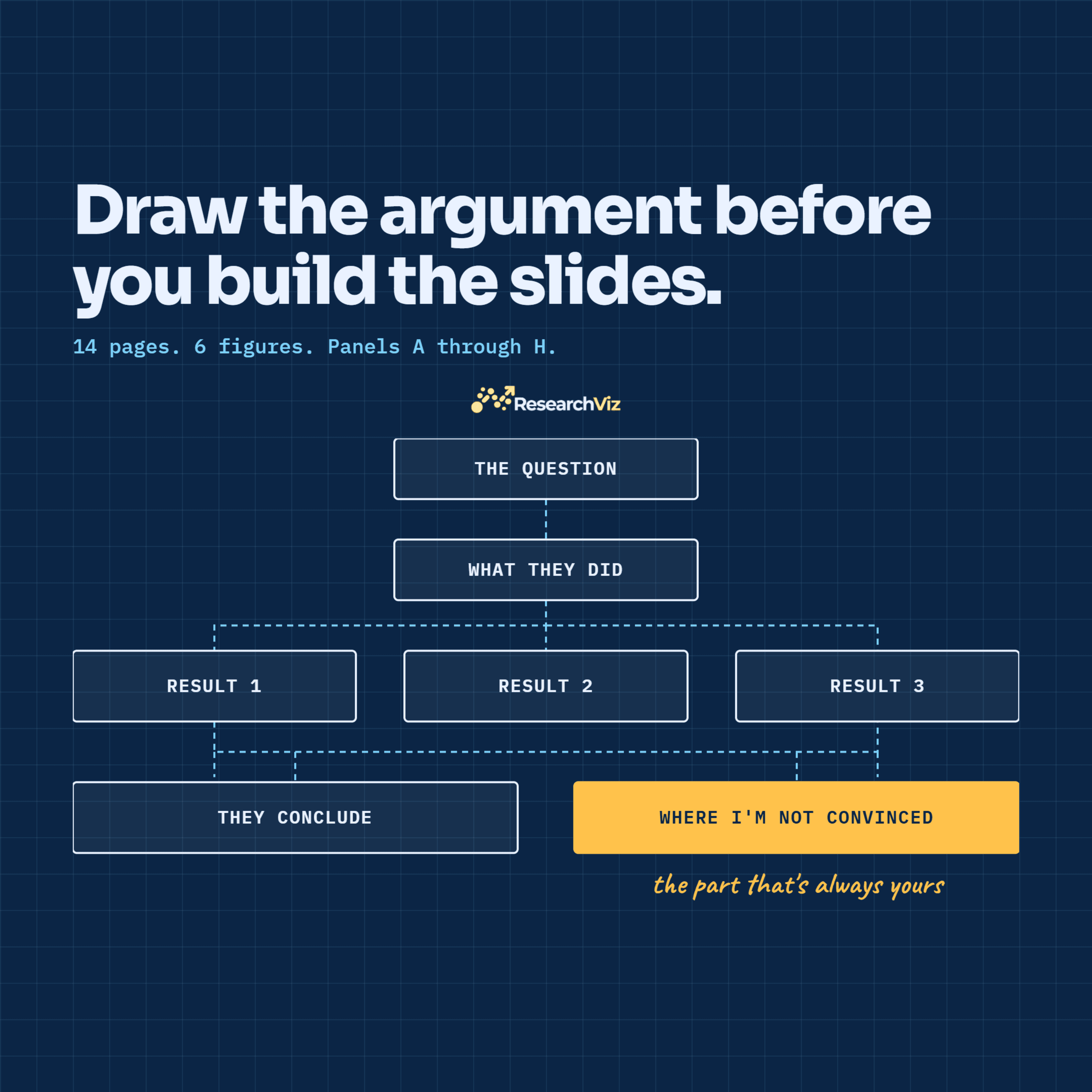
It is Thursday night when you remember. The lab group email went out weeks ago, and tomorrow at ten you are leading journal club. The paper is fourteen pages long, with six figures, each one packed with panels labeled A through H, and a supplement that runs longer than the paper itself.
You read it once on the train. It made sense. Then you try to explain it out loud to an empty room, and the words stop halfway through the second figure.
Understanding a paper is not the same as presenting it
Reading lets you nod along. Presenting makes you decide what the question really is, what each experiment shows, and which parts you can safely skip. Nobody warns you that this is a different skill.
Advice from one university genetics program lists the mistakes that keep coming up in these talks. Moving too fast without telling the audience where you are going. Covering too many points instead of exploring a few experiments in depth. Not practicing enough, since the same advice suggests running the whole talk aloud at least three times. That is a lot to ask at ten o'clock the night before.
The paper was written for reviewers, not for a room
A manuscript is organized for the people who judge it. The methods sit in one place, the key result sits in panel D of figure four, and the caveat that changes everything lives in a footnote.
A room of tired colleagues needs the opposite. One guide to journal club talks suggests keeping the background to no more than three slides and giving each figure, or even each panel, its own slide. That means you are not just copying the paper. You are rebuilding it as a story people can follow in ten minutes, and most of the evening disappears into screenshots, cropping and alignment.
Draw the argument before you build the slides
Here is a trick that saves the night. Before you open any slide software, sketch the argument. What is the question? What did the authors do? What are the three results that matter? What do they conclude, and where do you have doubts?
A mind map or a simple flowchart is enough. If you cannot draw the skeleton, you have found the gap in your understanding, and it is much better to find it at ten o'clock on Thursday than at ten past ten on Friday when someone asks about the control.
Where a tool like this actually helps
This is a natural job for ResearchViz. Upload the PDF or paste in the abstract, and it can produce a research summary and a mind map of the paper's structure, so the argument is visible on one page. From there it can turn the paper into slide ready presentations that you edit, instead of starting from a blank deck. Its VizBoard workspace offers templates such as flowcharts for a method, comparisons for two conditions and timelines for a series of experiments, and you can switch between them without losing your content.
It does not read the paper for you, and it will not form your opinion of the work. Check what it gives you against the paper, the way you would check a colleague's notes. The most valuable part of any journal club is the moment someone says here is where I am not convinced, and that part is always yours.
Walk in with a map
Your colleagues will not remember every panel. They will remember whether they could follow the story and whether you helped them see something they had missed. That takes thinking time, and thinking time is what an all night slide build steals.
Get the structure on the page quickly, spend your energy on the questions, and let the room see how you read. ResearchViz exists for the researchers who would rather prepare their opinion than their screenshots.
Start using ResearchViz
Turn your paper into a graphical abstract, poster, or presentation in minutes. See a sample report or browse all features.
Get started