
Rejected for the Wrong Reason
The reviewer comments come back three months later. You open the file already bracing for the worst, and then you read something worse than criticism of your findings. The reviewer did not understand what you actually did.

The reviewer comments come back three months later. You open the file already bracing for the worst, and then you read something worse than criticism of your findings. The reviewer did not understand what you actually did.
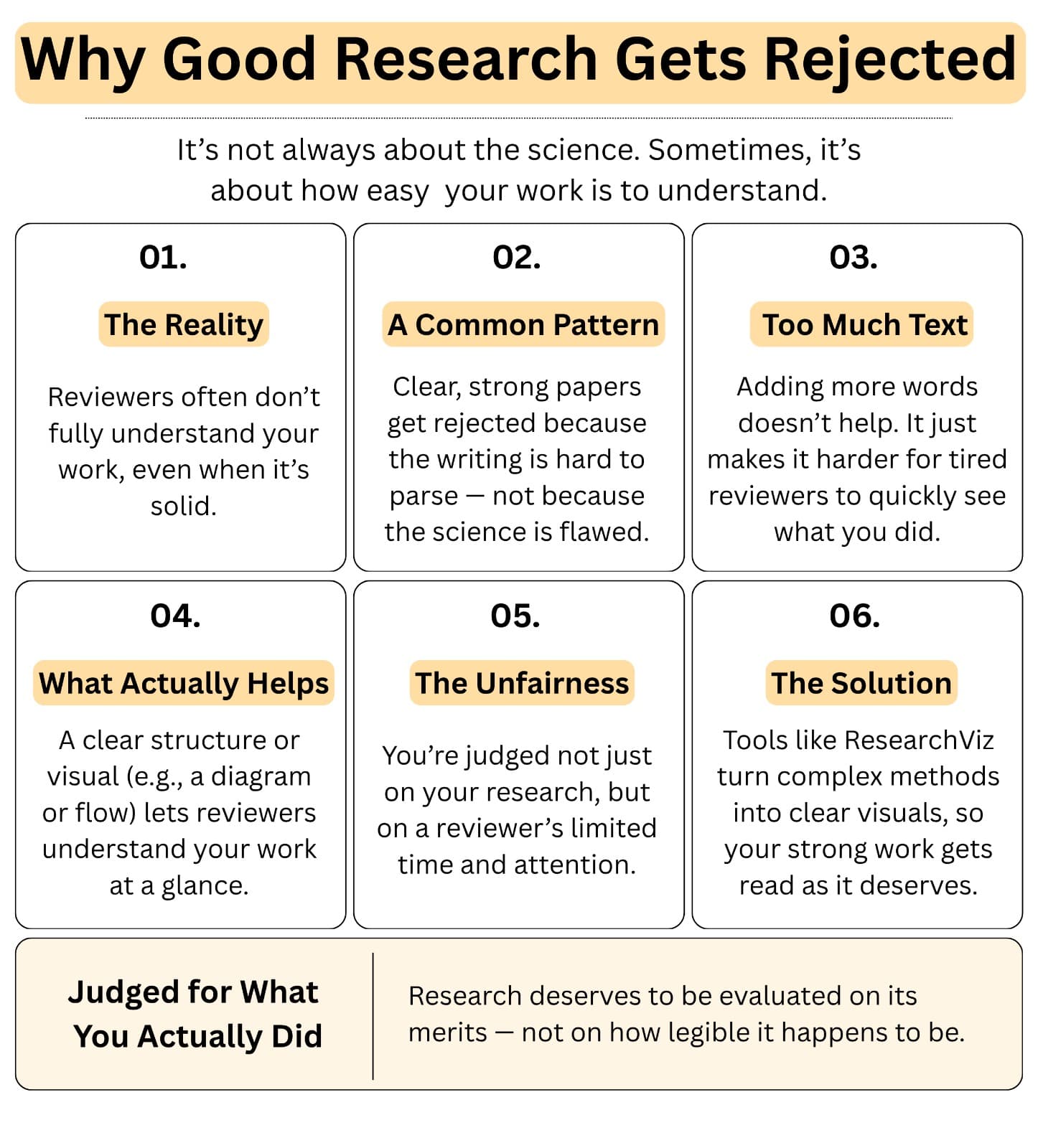
They misread your methodology. They asked a question your results section already answered, twice. They rejected the paper not because the science was flawed, but because they never fully understood it in the first place.
You spent eighteen months designing the study. They spent maybe twenty minutes reading it.
This is not a rare unlucky review
It is closer to the normal case. Research into manuscript rejection keeps landing on the same uncomfortable pattern: papers with genuinely sound ideas get declined because the writing takes too long to parse, not because the underlying work is weak. Editors have said as much plainly, some strong papers get turned away simply because nobody on staff has the hours to help the authors clarify what is already good work underneath.
Part of the reason is structural. Research suggests that as few as 20 percent of researchers handle over 90 percent of all peer review. The people judging your paper are often the same handful of overworked reviewers judging everyone else's paper too, squeezed between their own research, their own deadlines, and a stack of manuscripts that keeps refilling. Nobody is reading your methodology slowly and generously. They are reading it fast, tired, and looking for a reason to either say yes quickly or say no and move to the next one.
More words rarely fixes it
The instinct after a confusing review is to add more explanation. Another paragraph clarifying the procedure. Another sentence anticipating the misunderstanding. It rarely helps. A tired reviewer skimming a dense methods section does not want more prose to wade through, they want the shape of what you did to be obvious without needing to reconstruct it sentence by sentence. Adding text to a problem caused by too much text is treating the symptom with more of the disease.
What reviewers can actually absorb quickly is structure. A clear diagram of your experimental pipeline. A visual map of how your variables relate. Something that lets them confirm what you did in the time it takes to glance at a figure, instead of the time it takes to carefully parse four paragraphs while three other manuscripts wait in their inbox.
The unfairness worth naming
Here is the part that stings. None of this has anything to do with whether your research is good. A brilliant, carefully designed study can get rejected purely because the person judging it ran out of patience before they ran out of confusion. Your work is being measured against a reviewer's remaining attention span that day, not against its actual merit, and that is a genuinely unfair standard to be judged on after months of real effort.
You cannot control how tired a reviewer is or how many other papers are sitting in their queue. What you can control is how much work you make them do to understand what you actually accomplished.
Where a tool like this actually helps
This is exactly where ResearchViz earns its place before submission, not after rejection. Feed it your methodology or your full paper, and its diagram and mind mapping tools turn a dense procedural section into something a reviewer can absorb in seconds instead of minutes. It will not make weak science strong. What it does is remove the excuse for a reviewer to misunderstand strong science, by giving them a version of your argument that does not depend on their patience to land correctly.
Judged for what you actually did
Research deserves to be evaluated on its merits, not on how legible it happened to be to whichever exhausted reviewer drew it that week. A clear diagram will not save a weak study, and it should not have to. But it can make sure a strong one gets read the way it deserves to be read. ResearchViz exists for the researchers who would rather be rejected for their conclusions than for their formatting.
Start using ResearchViz
Turn your paper into a graphical abstract, poster, or presentation in minutes.
Get started