
One Image Away From Submitted
You finished the paper. Every section is written, every citation formatted, every co author has signed off. You reformat the whole manuscript to match the journal's guidelines, one more tedious pass, and you finally open the submission portal ready to be done.

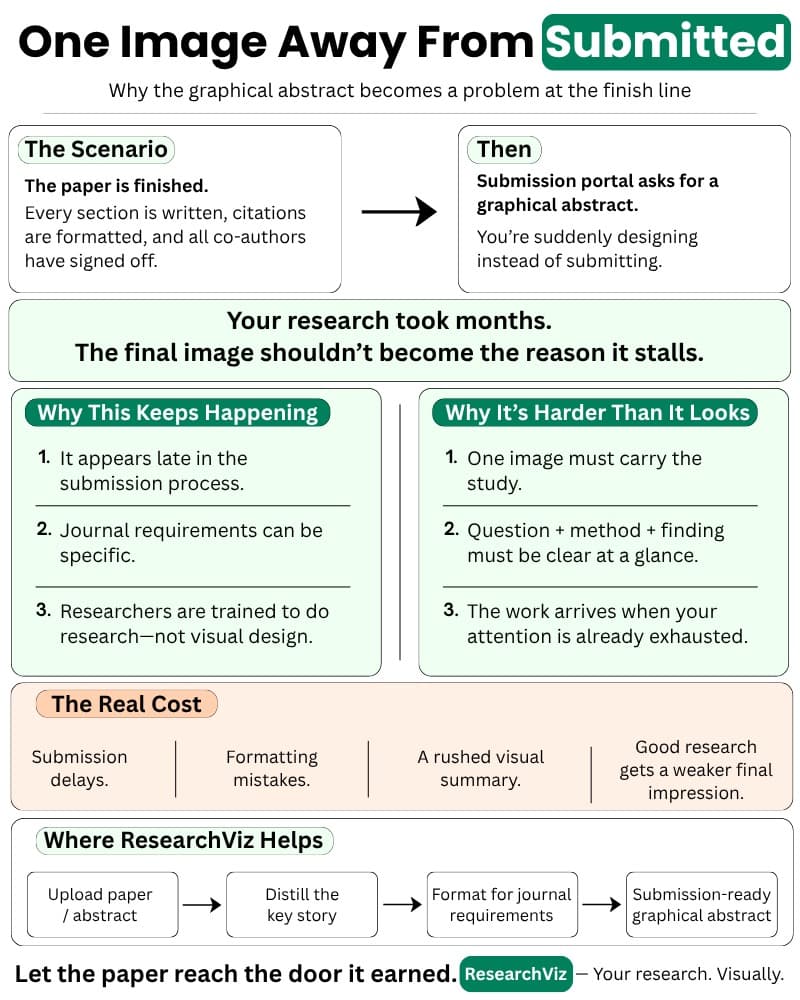
You finished the paper. Every section is written, every citation formatted, every co author has signed off. You reformat the whole manuscript to match the journal's guidelines, one more tedious pass, and you finally open the submission portal ready to be done.
Then the portal stops you. Graphical abstract required. Upload before you can proceed.
You thought you were finished twenty minutes ago. Instead you are staring at a blank canvas, trying to compress months of work into a single image, at the exact moment you have the least energy left to do it.
This happens to almost everyone
Major publishers, including Elsevier titles and Cell Press, now require a graphical abstract at submission, and it is rarely something anyone plans for early. It tends to surface as a locked field in the portal, discovered right when a researcher assumed the hard part was over. Guides written for exactly this situation describe the same scene over and over: hours spent reformatting the paper, hitting submit, and then hitting an unexpected wall over one missing image nobody budgeted time for.
The stakes are not small either. Failing to meet a journal's exact technical specifications, the dimensions, the file format, sometimes even font and color rules, is one of the fastest paths to a desk rejection, a paper turned away before a single reviewer even reads it. Your actual science never gets the chance to be judged. It gets stopped at the door by an image.
Why this task is harder than it looks
A poster gives you a full page to work with. A slide deck gives you a dozen. A graphical abstract gives you exactly one image and expects it to carry your entire study anyway, the question, the method, the finding, all at once, readable in a glance. That is a brutal compression exercise even for someone trained in visual design.
And most researchers are not. Survey responses from scientists on this exact topic keep landing on the same two complaints: a lack of design training, and a lack of time. You spent years learning to run experiments and analyze data. Nobody taught you layout, color theory, or how to turn a results table into a clean visual narrative. That gap is not a personal failing. It is simply not the skill your training was built around.
The timing makes it worse
If this task showed up in week one, it might not feel so brutal. Instead it shows up last, after the writing is done, after the citations are checked, after every ounce of careful attention has already gone into the actual paper. The one deliverable that demands an entirely different kind of thinking, visual instead of written, arrives exactly when you have the least mental energy left to do it well. So corners get cut, or the deadline slips, or a recycled figure gets awkwardly relabeled and passed off as a summary, none of which does justice to work that took months to produce.
Where a tool like this actually helps
This is the exact gap ResearchViz is built to close. Feed it your paper or abstract, and it generates a properly sized, submission ready graphical abstract built around your actual findings, formatted to fit journal requirements from the start. It handles the compression problem, distilling your study down to its core visual narrative, so the image reflects real thought rather than whatever could be assembled at the last possible hour.
It will not replace your judgment about what matters most in your own research. That call is still yours. What it removes is the unfair timing, the part where your best work gets rushed through its final, most visible impression simply because it landed on the one night you had nothing left to give it.
Let the paper reach the door it earned
Your research should not stall at the finish line over a single image. It took months to build the argument. It deserves a summary that matches that effort, not a rushed afterthought squeezed in after everything else was already done. ResearchViz exists for the researchers who would rather submit their best work than their most tired work.
Start using ResearchViz
Turn your paper into a graphical abstract, poster, or presentation in minutes.
Get started