
Everyone Nodded and Nobody Understood
The first meeting of the new collaboration goes well. Two labs, two fields, one shared question. People nod. Someone says the experiment should be straightforward. Someone else agrees and says they can have the data ready by spring.

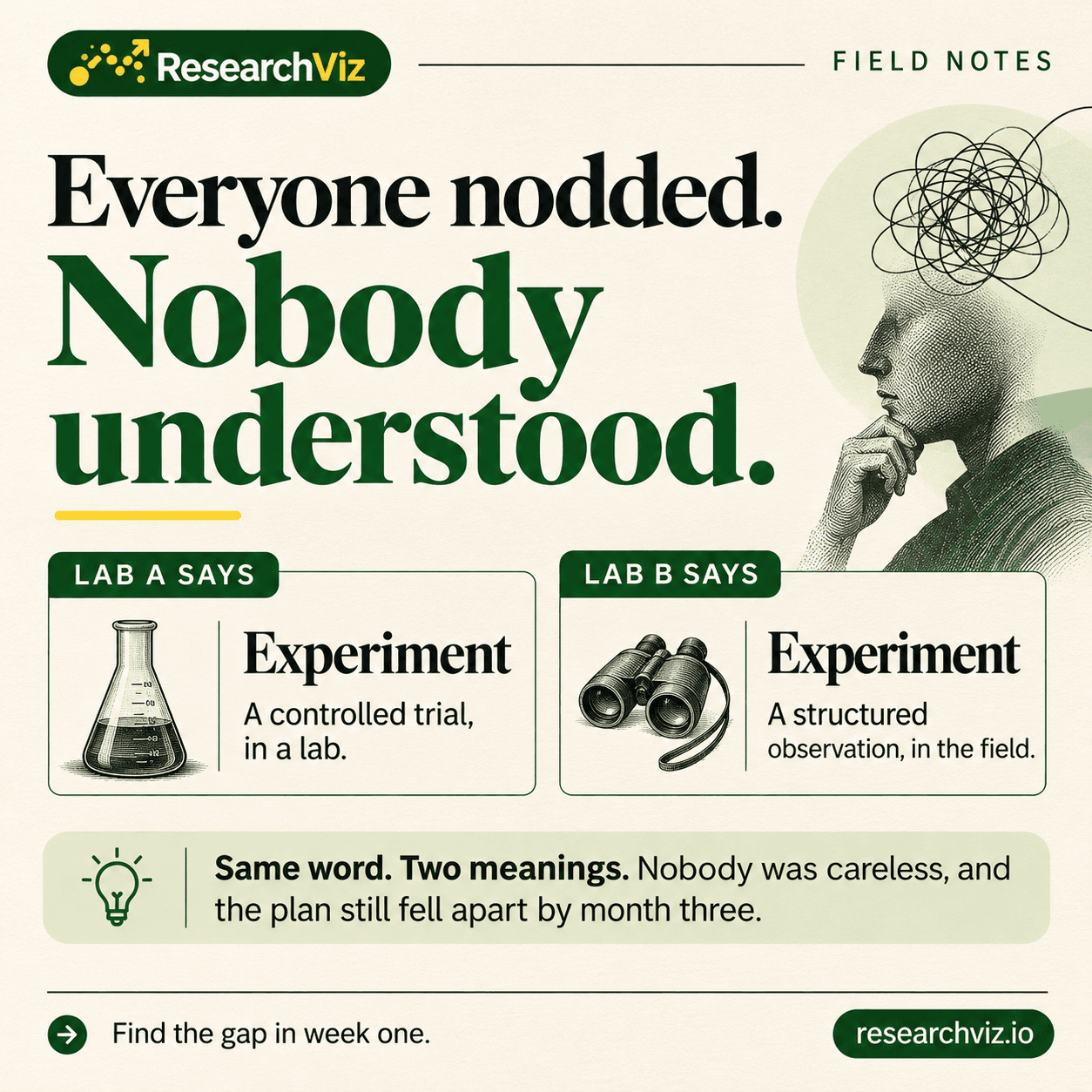
The first meeting of the new collaboration goes well. Two labs, two fields, one shared question. People nod. Someone says the experiment should be straightforward. Someone else agrees and says they can have the data ready by spring.
Three months later the plan is quietly falling apart. It turns out that when one side said experiment, they meant a controlled trial in a lab. When the other side said it, they meant a structured observation in the field. Nobody was careless. Both sides were being completely clear, in their own language.
The problem is not jargon you can look up
A study published in PLOS ONE in 2022 brought together 33 researchers from four countries, drawn from two neighboring fields, for a two day workshop on exactly this kind of collaboration. The participants described communication gaps that will sound familiar to anyone who has worked across fields. Jargon was one. One participant simply wrote "The jargon that we use." But the deeper issue was that familiar words carried different meanings. The paper's own example is the word experiment, which each field used differently.
The authors also describe conflicting paradigms, meaning different standards for what counts as good method and good evidence. That is harder to spot than an unfamiliar acronym, because nothing sounds wrong. You only discover the mismatch when a result does not line up with what the other side expected. To be fair, this was a small workshop with self reported data and two disciplines, so it points to a pattern rather than proving one. But it matches what many collaborators describe, and the suggested remedy was simple: be more explicit about the assumptions each side holds.
Why talking more rarely fixes it
The instinct after a misunderstanding is to schedule another meeting. More conversation helps with some things, but it does not reliably surface hidden assumptions, because hidden assumptions feel too obvious to say out loud. You cannot easily explain something that has become invisible to you.
Spoken explanations also drift. Two people can describe the same process in different orders, with different steps emphasized, and each walk away believing they agree. A method that lives only in conversation can mean three slightly different things by the end of the week.
A picture forces the question
This is where a visual earns its place. When you draw a process, you have to decide what comes first. A flowchart does not let you skip a step by implication. A comparison layout puts two definitions side by side, so the gap between them is visible instead of assumed. A mind map shows which concepts you think are connected, and the other person can immediately point at the one they think is not.
A shared visual does not remove the disagreement. It moves it to the first meeting, where it costs a conversation, instead of month three, where it costs a dataset.
Where a tool like this actually helps
This is a natural job for ResearchViz. Its VizBoard workspace takes plain text, such as your description of your method or your abstract, and turns it into an editable visual. You can choose from templates including mind maps, flowcharts, timelines, comparisons, hierarchies, cycles and lists, and switch between them without losing your content. If a process reads better as a flowchart than as a list, you change the template and see it. It also generates Mermaid diagrams for methods and workflows, which are easy to share and edit.
The practical use is simple. Before the first meeting, paste in how you understand the project and bring a visual that your collaborator can mark up. You will learn more from where they correct it in ten minutes than from an hour of nodding.
It will not make two disciplines agree on what an experiment is. That conversation belongs to the people involved. What it does is make sure you are having it early.
Find the gap in week one
Collaborations rarely fail because people stop trying. They fail because everyone was confident and no one checked what the other meant. Put the assumptions on the page where both sides can see them, and the project has a better chance of building on the same foundation. ResearchViz exists for the researchers who would rather find the misunderstanding in the first meeting than in the final analysis.
Start using ResearchViz
Turn your paper into a graphical abstract, poster, or presentation in minutes. See a sample report or browse all features.
Get started